ATBOSE’s data center practice spans Singapore’s hyperscale corridor, Malaysia’s emerging colocation markets, Korea’s enterprise infrastructure, India’s tier-one commercial hubs, and Australia’s regional deployment zones. The geographic distribution reflects institutional capability developed through facilities where downtime costs measure in seven figures per hour and commissioning failure means operational shutdown during peak demand periods.
Data center construction operates under constraint structures distinct from commercial building delivery. A delayed office fitout costs lease revenue. A delayed data center eliminates computational capacity during contracted service periods where penalty clauses cannot compensate for customer migration to competing providers. These are projects where schedule variance translates to market share loss, where cooling system performance determines whether server infrastructure operates or enters thermal shutdown, where power redundancy architecture must survive testing protocols that simulate utility failure under full operational load.
Hyperscale and Colocation Facilities
Singapore’s 177,000 square-foot greenfield hyperscale facility demonstrated the methodology required for accelerated delivery under Tier III+ operational specifications. The project commenced with transformation from conventional design-build procurement to direct construction management, compressing schedule by four weeks through top-down construction sequencing where roof and MEP systems installed concurrently with foundation work rather than following sequential completion typical of conventional methodologies.
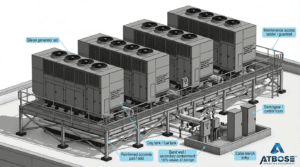
Long-lead procurement for critical path equipment began six months ahead of installation schedules. Generators, switchgear, and chiller plants underwent factory acceptance testing before site delivery, eliminating the commissioning failures that emerge when equipment specifications on paper do not match operational performance under load. Sequential commissioning protocols initiated integrated functional testing ninety days before handover, validating 2N power redundancy and N+1 cooling plant performance through failure simulation that confirmed systems would sustain operational requirements when primary infrastructure components went offline.
The 363,000 square-foot colocation expansion across Singapore demonstrated project recovery capability when engaged mid-construction to address eight-week schedule delay with incomplete design package and unforecasted long-lead commissioning requirements. Recovery proceeded through restructured project controls establishing one-week KPI delivery targets, early commissioning agent mobilization initiating sequential testing and commissioning programs ahead of conventional timelines, and parallel execution pathways coordinating design freeze, procurement acceleration, and construction sequencing simultaneously rather than sequentially.
The facility deployed advanced desiccant cooling systems incorporating N+1 redundancy configurations where conventional approaches would specify N redundancy with cost reduction justification that eliminated operational margin when single cooling unit failure occurred during peak load periods. The completed facility achieved ISO 27001 and SOC 1/2 certification on schedule, meeting operational requirements where certification delay would have prevented tenant occupancy and triggered penalty clauses measuring in eight figures.
Edge Data Center Deployment
Edge data centers across Malaysia, Korea, and regional Australia markets require deployment methodology designed for distributed infrastructure where individual facilities range from fifty to five hundred kilowatts. These are not hyperscale environments where economies of scale justify dedicated project teams. Edge deployment proceeds through standardized design templates, modular equipment packages, and commissioning protocols that function identically whether deploying in Kuala Lumpur’s business districts or Perth’s industrial zones.
The standardization eliminates design variance that introduces commissioning complexity. Cooling systems specify equipment from manufacturers whose performance characteristics have been validated through prior deployments rather than selecting alternatives that introduce untested variables requiring field verification. Power distribution architecture employs redundancy configurations proven through operational experience rather than optimizing for cost reduction that eliminates operational margin.
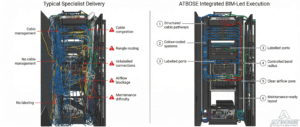
Manufacturing integration through Gujarat’s fabrication facility provides modular infrastructure components where dimensional precision determines whether rack systems, cable management, and containment structures install without field modification. When edge facilities require rapid deployment synchronized with tenant migration schedules, custom fabrication under controlled protocols ensures equipment arrives site-ready rather than requiring adjustment that introduces commissioning delays.
Commissioning Discipline for Mission-Critical Infrastructure
Data center commissioning represents the operational verification that determines whether facility design translates to performance under load. Conventional construction methodologies treat commissioning as sequential activity following substantial completion. ATBOSE’s integrated commissioning protocols establish testing and validation parallel to construction, initiating functional verification eight weeks ahead of conventional timelines.
The methodology addresses fundamental failure mode in data center delivery. Equipment specifications on submittals do not guarantee operational performance. A cooling plant rated for specific capacity under manufacturer test conditions may not sustain that capacity when integrated with building management systems, when ambient conditions deviate from design assumptions, when multiple systems interact under simultaneous operation. Integrated commissioning validates performance before handover when remediation remains feasible, not after tenant occupation when corrections require operational shutdown.
Trading floor construction across Singapore demonstrated the discipline. Water-cooled trading systems meeting ASHRAE TC 9.9 Class A1 thermal management standards underwent integrated functional testing validating cooling performance under simulated server load before financial institution began migration of high-frequency trading infrastructure. The verification confirmed systems would maintain environmental parameters within tolerance ranges where deviation of two degrees Celsius would trigger algorithmic trading shutdown during market volatility.
Regional Execution Capability
Data center delivery across Asia-Pacific markets requires operational architecture that maintains technical standards while adapting to regional procurement ecosystems, regulatory frameworks, and construction practices that vary significantly across jurisdictions. Singapore’s building authority requirements differ from Malaysia’s certification protocols. Korea’s electrical standards operate under specifications distinct from Australia’s grid integration requirements. India’s tier-one markets navigate regulatory environments where approval timelines and inspection protocols reflect local governance structures.
ATBOSE’s distributed team structure combines international project management standards with regional execution knowledge. Singapore operations coordinate ASEAN market development and maintain relationships with equipment suppliers, commissioning agents, and certification bodies operating across Southeast Asian markets. India operations manage National Capital Region and tier-one city deployments where local procurement networks and construction ecosystems require navigation distinct from Singapore’s established infrastructure. Australia coordination provides access to regional suppliers and maintains relationships with utilities and regulatory authorities governing critical infrastructure deployment.